
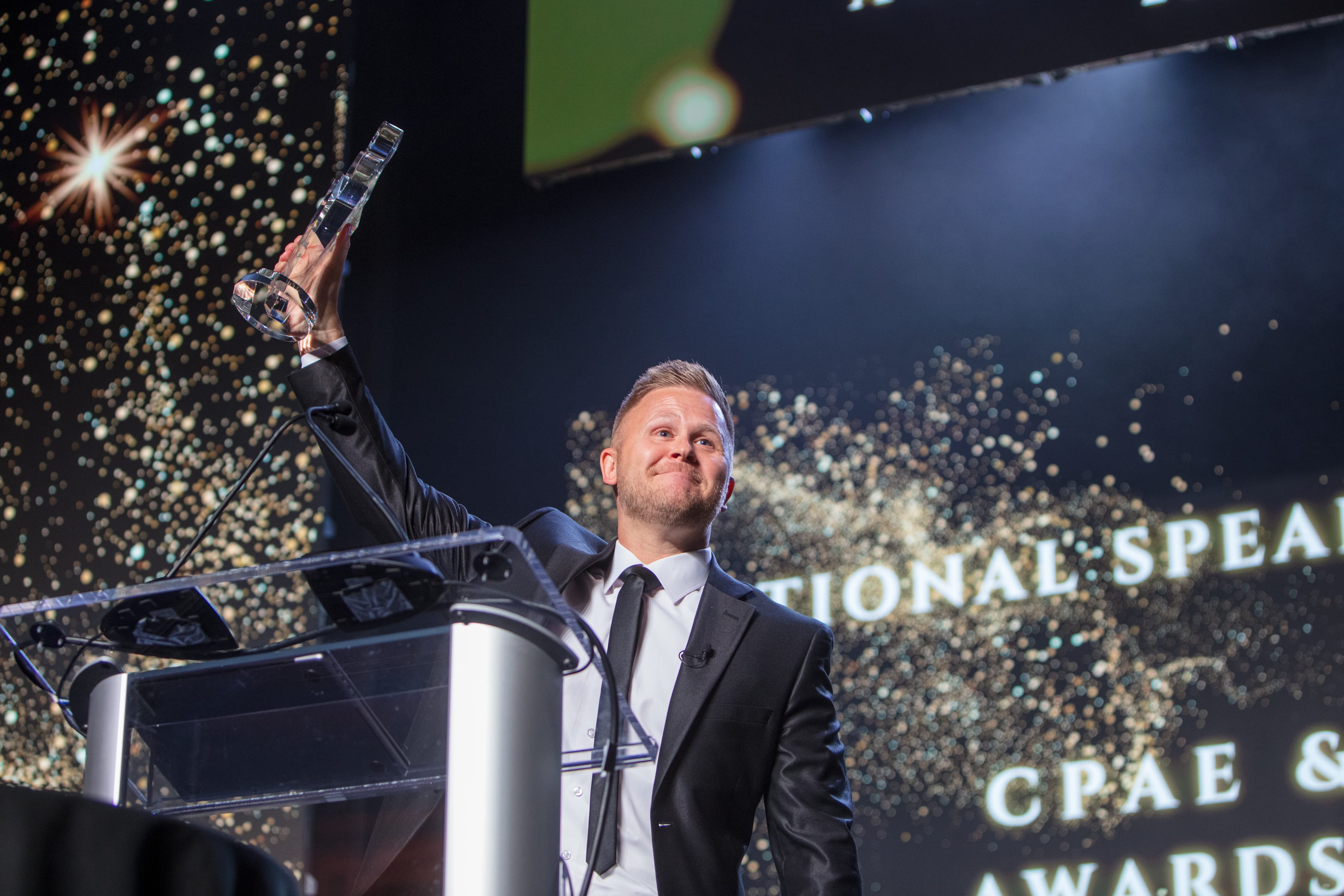
By Clint Pulver, CSP, CPAE
Eight years ago, I walked away from the security of a steady paycheck. People thought I was crazy. I had a good job, benefits, and what many would call a stable life. But deep down, I wasn’t living—I was existing.
A quote by Oscar Wilde haunted me: “To live is the rarest thing in the world. Most people merely exist, and that is all.” That hit me like a ton of bricks.
I began asking myself—and close friends—a big question: Is it possible to find a career where passion, purpose, and the ability to provide all come together?
Most people I asked said no. They told me you could maybe have one of the three, sometimes two if you were lucky, but all three? Rare. Impossible. Unrealistic.
Two weeks later, I quit my job. That was the day I truly started living. And it was the day I committed to becoming a keynote speaker.
The Three P’s That Changed My Life
When I made the leap, I wasn’t just chasing money or applause. I was chasing what I now call the three P’s:
1. Passion – I wanted to do work that lit me up inside. Work that mattered.
2. Purpose – I wanted my efforts to make a difference in people’s lives.
3. Provide – I wanted to support my family in a meaningful, financially sufficient way.
The three P’s became my compass. Whenever I doubted myself or felt stuck, I asked: Does this decision align with my passion? My purpose? My ability to provide? If the answer was yes, I leaned in. If it was no, I walked away.
And here’s the good news: it’s possible. You really can build a career where all three P’s intersect. For me, professional speaking became that career.
The Five Keys to Building a Successful Speaking Business
Now, passion and purpose are great, but if you want to create a business around speaking, you need more than just a microphone and a dream. Over the years, I’ve discovered five (5) key elements that have made all the difference in building a sustainable, thriving speaking career.
1. Identify the Audience and the Decision Maker
Not everyone is your audience. In fact, most people aren’t. Early on, I made the mistake of trying to appeal to everyone. But the real traction came when I identified who my true audience was and, more importantly, who the decision makers were.
It’s not enough to chase what pays—you need to chase what you love. Who do you feel called to serve? Who resonates most with your message? When you find that audience and the people who make the booking decisions, that’s when opportunities start to multiply.
2. Define Your Unique Value
In this industry, clarity is currency. You must be able to answer two critical questions in the simplest terms possible:
- What problem do you solve?
- What solution do you provide?
And then you must demonstrate how you’re the only one who does it in your unique way. For me, it boiled down to one word for the problem and one word for the solution. Simplicity sells. If you can’t define your unique value quickly and clearly, clients won’t be able to either.
3. Master the Craft
This one can’t be overstated: become astonishing on stage. No website, marketing strategy, or social media following can save a mediocre performance. The stage is where careers are built—or lost.
That means putting in the reps. Join NSA, Toastmasters. Hire a speaker coach. Attend National Speakers Association Annual and Chapter events. Study the craft. Record yourself. Rehearse until you’re sick of it, then rehearse again. If you want to be a great speaker, you must be obsessed with the art of speaking.
4. Build a Board of Mentors
No one succeeds alone. Early in my career, I sought out speakers who inspired me and were doing what I wanted to do. I didn’t just ask for advice—I built relationships. I listened. I learned. I attended events where they were speaking.
Find mentors who are a few steps ahead of you, as well as those light-years ahead. Their guidance, encouragement, and example can shave years off your learning curve.
5. Invest in Your Online Presence
Here’s the truth: your website and demo video are often your first impression. If they don’t reflect the value you bring, you won’t get the call.
Your website should look as professional as your pricing. And your demo video? It needs to grab attention in the first 30 seconds and prove you can deliver results for clients. Think of it as your audition tape—it either opens doors or closes them.
Living vs. Existing
Looking back, quitting my job wasn’t the easiest decision, but it was the best one. I stopped existing and started living. I found my three P’s—passion, purpose, and the ability to provide—and I built a business around them.
If you’re a speaker—or someone who aspires to be one—know this: it’s possible. It’s possible to build a career you love, one that makes a difference, and one that provides for your family. But it requires clarity, commitment, and the willingness to master both the art and the business of speaking.
For me, the microphone became the tool. The stage became the place. The message became the movement.
And the day I chose to live—that was the day it all began.
I love your three P’s! For me I have to add a third because my topic is so difficult and stigmatized. And that is persistence. Like you once I sold my digital marketing business and completely changed my career I found purpose which made such a difference.
It has been extraordinary watching your journey and how well you leap-frogged so many due to your propensity to listen, learn, and lean into what was being taught. And then you went and did it better than anyone else, in your own unique way. I recommend anyone looking to do this business right, follow Clint Pulver’s example. Congrats on the success brother.
Clint thanks for this. Depending on the personal circumstances of an aspiring speaker just having the courage to walk away and your three P’s might not be enough. I always tell small business consulting clients the number one stepping stone from leaving the life of a steady paycheck —if you intend to continue your existing lifestyle — at minimum is this fourth P – PROSPERITY.
I hang all of my success on having those FOUR P’s! When I left my corporate career I was not worried about whether or not I could make it – I had no outstanding debts, a savings to lean on so I could maintain existing lifestyle while in investing in my business as needed, PLUS paying clients I already had on the side when I left corporate career. I had set myself up for success- I just needed to execute, which I did thanks to those 3 P’s and I’m still doing 12 years later.
Bottom-line the aspiring speaker with the pressures of every day survival will falter quickly if they are not already PROSPEROUS in some way (not wealthy – financially comfortable will do) as they start out. Otherwise the 5th P – PRESSURE will create unwanted distress causing the aspiring speaker to spend less time growing a speaking biz and more on trying to once again merely maintain a life just to exist.
I hope this helps.